Informatica: Scaling Onboarding Through Behavioral Design
Overview
During Informatica’s enterprise merger with Salesforce, more than 5,000 employees were urged to complete Trailhead training modules from Salesforce, but they lacked a single, clear starting point. The training material was scattered across disconnected systems, creating immediate information overload and user resistance.
I helped lead the content strategy, information architecture, and roadmap execution for the company-wide Salesforce Trailhead Initiative to resolve this friction. Partnering directly with executive leadership, including the VP of Product Development and the Chief Architect for Engineering, I centralized disparate training modules into an intuitive webpage and assisted with creating the Trailblazer Challenge, a gamification framework designed to incentivize voluntary progress and earn prizes. By pairing progressive disclosure with behavioral design mechanics, I transformed a confusing corporate mandate into an engaging, self-paced growth journey.
Problem
An initial audit of the acquisition training landscape highlighted four friction points that threatened employee success:
Paralyzing cognitive load: The absence of content curation forced employees to confront hundreds of unorganized training modules simultaneously during the acquisition. This lack of filtering triggered decision paralysis.
Absence of structural wayfinding: The documentation ecosystem lacked role-specific paths. Employees could not quickly discern which modules were critical to their specific technical discipline (e.g., UX vs. security engineering).
Linguistic disconnection: Fragmented messaging across disparate departments obscured the broader strategic value of the merger, causing employees to view the training as an arbitrary compliance burden.
Deficit in intrinsic motivation: Because the material relied on passive, mandate-heavy messaging, employees lacked a clear "What’s in it for me?" (WIIFM) mental model, resulting in low initial engagement.
Goals
To optimize the change-management framework, I established three core product design objectives:
Systematize content curation: Group disparate training tracks into clear, role-based navigation paths to accelerate time-to-task efficiency.
Gamify the learning experience: Include points and Trailhead leveling mechanics into the webpage interface to drive voluntary completion and engagement in the Trailblazer Challenge to earn prizes based on Trailhead points.
Secure multi-tiered executive alignment: Present a unified, data-backed technical roadmap to senior leadership to secure organization-wide deployment approval.
Solution
I re-architected the training landscape by deploying a structured, content-led learning experience optimized for visual hierarchy and psychological motivation.
Role-based progressive disclosure: I mapped and divided the massive module list into distinct, role-specific "Trailmixes" (UX, developer, security). By hiding non-essential content until relevant to the user’s career path, I reduced scanning friction and allowed employees to better gauge what trainings would be useful for them.
Optimized spatial scannability: Utilizing Nielsen Norman Group scanning principles, I re-engineered the webpage hub interface. I introduced strict typography constraints, maximized white space, and leveraged the Law of Proximity to group related modules, allowing users to scan and extract value instantly during high-velocity workdays.
Action-oriented microcopy refinement: I rewrote all module summaries to replace compliance jargon with active, outcome-focused prose. Every path led with clear explanations of the specific professional competencies the user would gain upon completion.
Feedback & Iteration
To accelerate adoption, the team and I conceptualized and executed a high-engagement gamification layer called the Trailblazer Challenge, iterating on early feedback to optimize user motivation:
Engineered immediate feedback loops: Early content iterations lacked integrated reward visibility. I resolved this by designing immediate feedback indicators ("green status bubbles with points to be earned") for each completed module, providing users with instant visual gratification and explicit progress validation.
Cultural transformation mechanics: Using the Trailblazer Challenge’s points criteria for rewards, the team and I introduced competitive milestone markers. This shift successfully pivoted the employee mental model from completing a mandatory corporate assignment to participating in an active, community-driven professional milestone.

Previous content design iterations lacked integrated point values, which failed to promote the concepts of individual growth and challenge engagement.

A poster I created to market the Trailblazer Challenge across multiple geos.
Outcome & Next Steps
The gamified roadmap established a permanent, scalable change-management framework across geos:
The campaign successfully activated over 830+ employees within the competitive tracking layer, driving a measurable surge in active Salesforce module completion without requiring top-down managerial escalation.
By providing an intuitive, self-service information architecture, the hub decoupled users from internal documentation support lines, eliminating redundant routing requests during the transition phase.
I developed and pitched a comprehensive, mathematical roadmap presentation—incorporating specific course time equations and point-per-time balances—to cross-functional leaders (VP of Product Development, Chief Architect, and Senior Director of Documentation). Leadership approved the system, utilizing it as the gold standard for scaled enterprise transition design.
Additional Deliverables
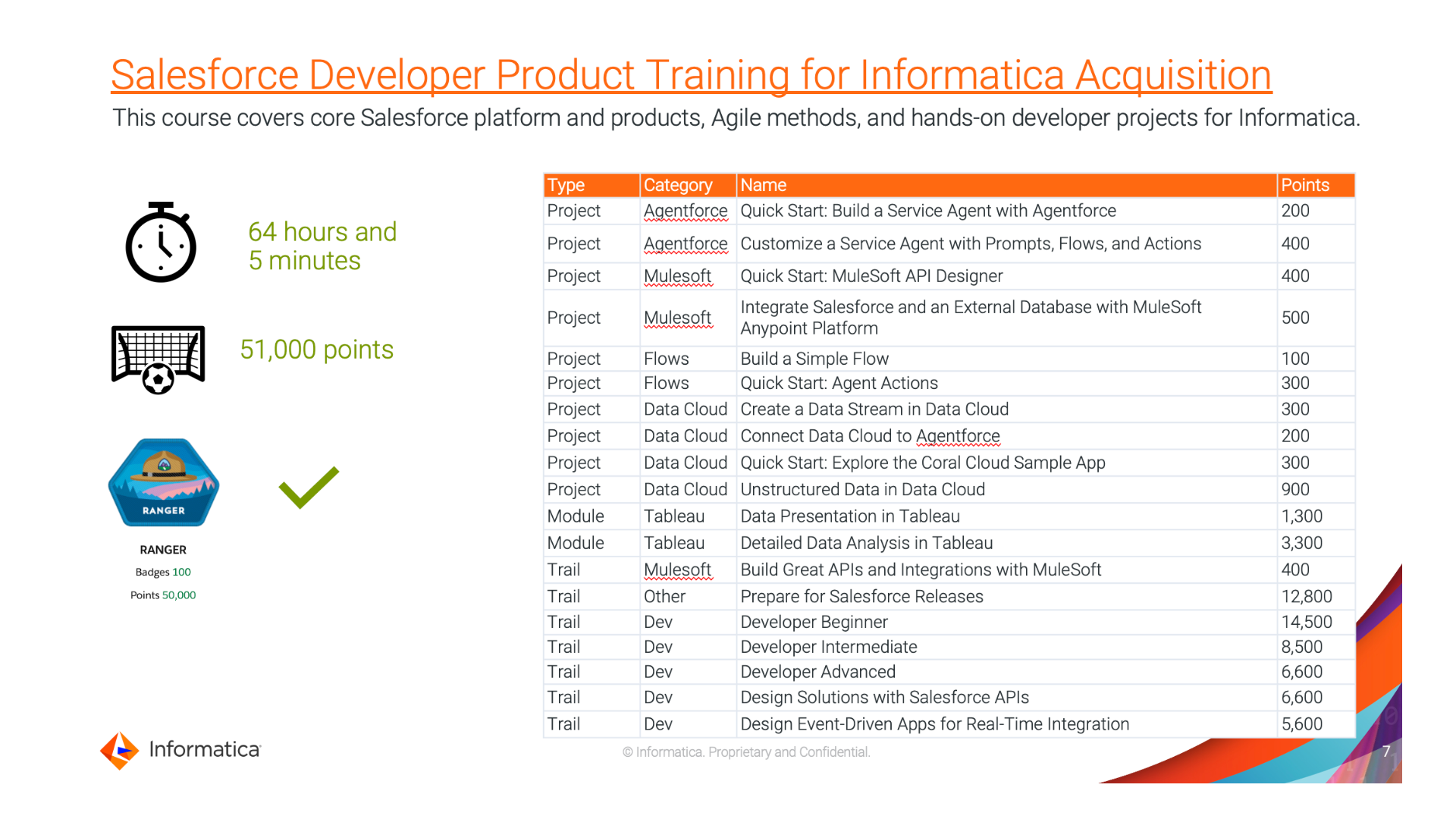
Here is one example where I developed and presented a comprehensive roadmap to executive leadership, featuring specific time equations and point-per-time values for each course to quantify learning effort and accelerate decision-making.
Here’s a brief video example of the popup shop I designed at the end of the Trailblazer Challenge.